
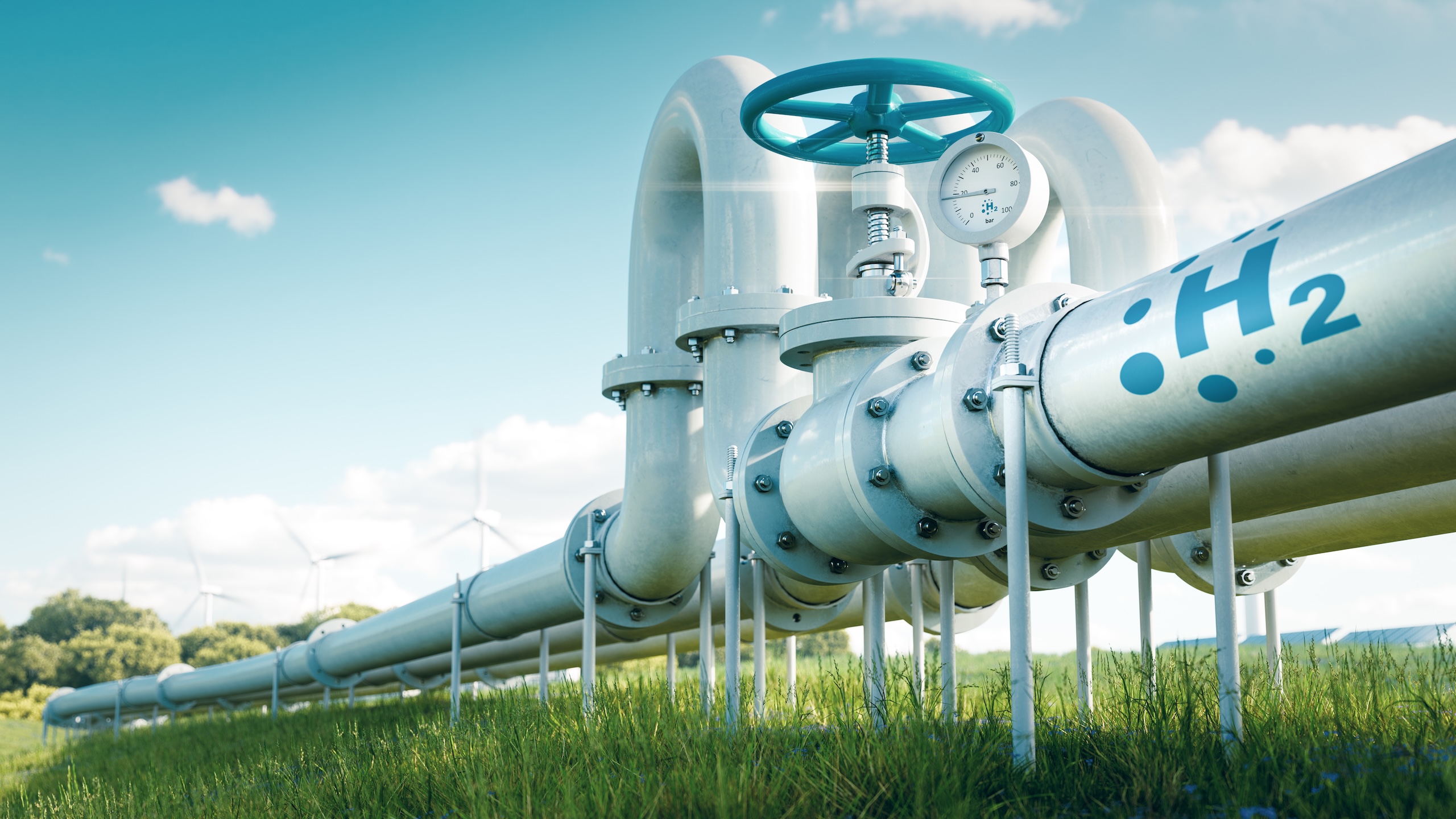
New funding mechanisms show that European hydrogen policy is moving beyond technology demonstrations towards production, infrastructure and a functioning market
For years, green hydrogen was presented as one of the great promises of the energy transition. Strategies were announced, pilot electrolysers were constructed and ambitious production targets were established. Yet there remains an enormous distance between producing the first kilogram of hydrogen and creating a functioning hydrogen economy.
Building an electrolysis unit is not enough.
Affordable electricity, a reliable water source, secured customers, compression and storage infrastructure, transport corridors, certification of origin and long-term contracts are all necessary to convince investors that the hydrogen produced will actually be sold.
This is precisely where European policy is changing.
The European Union’s new instruments show that funding is gradually shifting away from individual technologies towards the entire system surrounding them. Alongside production, support is now being directed towards market development, connections between sellers and buyers, cross-border infrastructure, storage and the preparation of future hydrogen networks.
The European Hydrogen Bank Pays for Actual Production
One of the principal funding instruments is the European Hydrogen Bank, whose domestic European pillar is implemented through the Innovation Fund.
Instead of awarding a conventional grant solely for the construction of equipment, the mechanism uses competitive auctions. Applicants state the additional financial support they require for each kilogram of hydrogen produced. The projects are then assessed and the bids ranked according to the requested premium.
Selected producers can receive fixed support for a period of up to ten years. However, payments are made only for hydrogen volumes that have actually been produced, verified and certified. This means that European funding does not eliminate the risks associated with project development and construction. It supports operations once the facility has genuinely begun producing hydrogen.
This structure changes the very logic of the application process. The winning project will not necessarily be the one with the most impressive presentation or the largest electrolyser. It will be the one that can convincingly demonstrate a low required subsidy, controlled costs, secured energy and water supplies, a realistic commissioning schedule and a credible market for the hydrogen it intends to produce.
Interest Is Enormous, but Funding Is Insufficient for Everyone
The third European Hydrogen Bank auction — the IF25 Hydrogen Auction — had a budget of €1.3 billion. A total of 58 bids were submitted, through which producers requested approximately €8.4 billion in support.
The European Commission initially selected nine projects and subsequently invited another four projects from the reserve list to begin grant agreement preparations. This brought the total number of selected projects to 13, covering more than 95% of the auction’s available budget. They are expected to develop significant new electrolysis capacity and produce hydrogen over a ten-year period.
These figures demonstrate two things simultaneously.
First, the European hydrogen industry already has a considerable number of projects seeking a path towards implementation.
Second, competition for funding is far greater than the budget available. Having a good technology is no longer sufficient. Projects must be prepared as complete and integrated investment systems.
A New Hydrogen Auction Is Expected in December 2026
The European Commission is planning a fourth hydrogen auction in December 2026, with a budget of up to €500 million. As of 4 August, the draft terms and conditions are undergoing public consultation, which will remain open until 24 August, while a dedicated information webinar is scheduled for 8 September. The final requirements will become clear once the official call is published.
The smaller budget compared with the previous auction is likely to intensify competition. This makes early preparation particularly important.
Before the procedure opens, project teams must have more than a selected technology. They need a clear concept for electricity supply, water balance, permitting procedures, construction, certification, customers and the premium required for every kilogram of hydrogen produced.
Preparing such a project does not begin with completing an ordinary application form. It begins by proving that the facility can be constructed, supplied with the necessary resources and operated under real market conditions.
Production Is No Longer the Only Major Challenge
Europe is gradually recognising that it cannot create a hydrogen market by funding production capacity alone.
An electrolyser can produce hydrogen, but it cannot create demand by itself. It cannot build a pipeline, provide seasonal storage or guarantee that an industrial customer hundreds of kilometres away will receive the required quantity at an acceptable price.
This is why the European Hydrogen Mechanism began operating in 2025. The platform connects potential suppliers, buyers and partners. Its purpose is to reduce uncertainty between future supply and demand and assist participants in finding commercial partners and financing opportunities.
In July 2026, the European Commission announced the next stage of the mechanism, this time focusing on hydrogen infrastructure. Transmission system operators, future hydrogen network operators and other organisations can propose planned pipelines and storage facilities for non-binding market interest testing.
The aim is to give infrastructure developers a clearer understanding of which producers and consumers would use a particular pipeline or storage facility before the enormous investments required for its construction are made. Expressions of interest for participation in this stage can be submitted until 7 September 2026.
This represents a fundamental change. The question is no longer simply:
“How much hydrogen can we produce?”
The increasingly important question is:
“How will the hydrogen we produce reach the customer?”
€600 Million for Cross-Border Energy Infrastructure
Alongside the production auctions, the Connecting Europe Facility for Energy — CEF Energy — supports strategic cross-border infrastructure.
A call with a budget of €600 million is currently open for studies and construction activities relating to Projects of Common Interest and Projects of Mutual Interest. Eligible infrastructure includes hydrogen networks, electrolysers, storage facilities and associated energy infrastructure. However, projects must already be included in the EU’s second list of PCI and PMI projects. The application deadline is 30 September 2026.
PCI or PMI status is not merely a label. It can provide access to a more favourable regulatory framework, better-coordinated permitting procedures and European infrastructure funding.
A separate application process for inclusion in the future PCI and PMI list is also open until 30 September 2026. It covers projects in the fields of hydrogen, electrolysers and carbon dioxide infrastructure.
This demonstrates how long the road towards infrastructure financing can be. A project must first prove its cross-border importance and strategic necessity. Only then can it gain access to certain European funding instruments for studies and construction.
Bulgaria Is Already on the Map
At the beginning of 2026, the European Commission approved approximately €650 million in CEF Energy funding for 14 cross-border energy projects.
Eight of the supported actions were related to hydrogen infrastructure. A Bulgarian project involving studies for domestic hydrogen infrastructure received €4.56 million in European support. Studies for hydrogen backbones, terminals and transmission systems in other European countries were also financed, together with the first grant for the construction of a hydrogen storage facility — more than €120 million for the Gronau-Epe project in Germany.
This is an important signal for Bulgaria.
The country is not outside the future European hydrogen system, but its participation will not happen automatically. It will require local production hubs, industrial customers, transport solutions, connections to regional infrastructure and projects capable of demonstrating both technical readiness and European added value.
Different Projects Require Different Types of Funding
One of the most common mistakes is to search for a single “European hydrogen programme”, as though every project were at the same stage of development.
In reality, European funding is divided according to a project’s maturity and purpose.
Scientific research, new components, electrolyser manufacturing, storage, transport applications and demonstration hydrogen valleys can receive support through the Clean Hydrogen Partnership and the Horizon Europe programme. The 2026 call had a budget of €105 million across 21 topics, including production, storage and distribution, transport, heat and power generation, and hydrogen valleys. The procedure closed in April after receiving 170 proposals.
More mature production projects can seek support through the European Hydrogen Bank auctions.
Strategic pipelines, storage facilities and cross-border connections can pursue PCI or PMI status and funding under CEF Energy.
Meanwhile, the European Hydrogen Mechanism can support connections between future producers, customers and infrastructure operators.
There is therefore no single universal source of funding. Instead, there is a sequence of instruments that must be matched to the specific stage of each project.
Funding Will Not Repair a Weak Project
The existence of a European budget does not automatically make a hydrogen project viable.
Funding can reduce the price gap between clean hydrogen and its fossil-fuel alternatives. It can support research, accelerate infrastructure development and reduce part of the investment risk.
But it cannot replace a missing customer.
It cannot create a suitable water source where the water balance has been overlooked. It cannot compensate for excessively expensive electricity, an unprepared project site, missing permits or a transport system that nobody will use.
The most competitive projects will be those that establish a logical connection between resources, technology, infrastructure and the market before the application process even begins.
The Next Phase of the Hydrogen Economy
Europe already has numerous electrolysis projects. The next challenge is to transform them from isolated production islands into a connected economic system.
This means locating production close to renewable energy and a suitable water source. It means securing industrial and transport customers. It means developing compression, storage, logistics, pipelines and contracts that provide predictability for years to come.
European funding is gradually beginning to follow precisely this logic.
For organisations such as Bright Hydro Future, this development confirms the need to stop treating water, renewable energy and hydrogen as three separate sectors. Designing them as an interconnected system can simultaneously create a new water resource, utilise clean energy and produce fuel for the economy of the future.