
The Story of the Aral Sea Is a Warning for the Water Future of Bulgaria and Europe
Once, ships sailed from the ports of Muynak, loaded with fish. Thousands of people worked in processing plants, fishing cooperatives and port services. Water was part of the landscape, the economy, their livelihoods and their vision of tomorrow.
Today, those same ships are rusting in the sand. Not on the shore, but in the middle of a vast wasteland whose end disappears beyond the horizon. Tens of kilometres away from the remaining water.
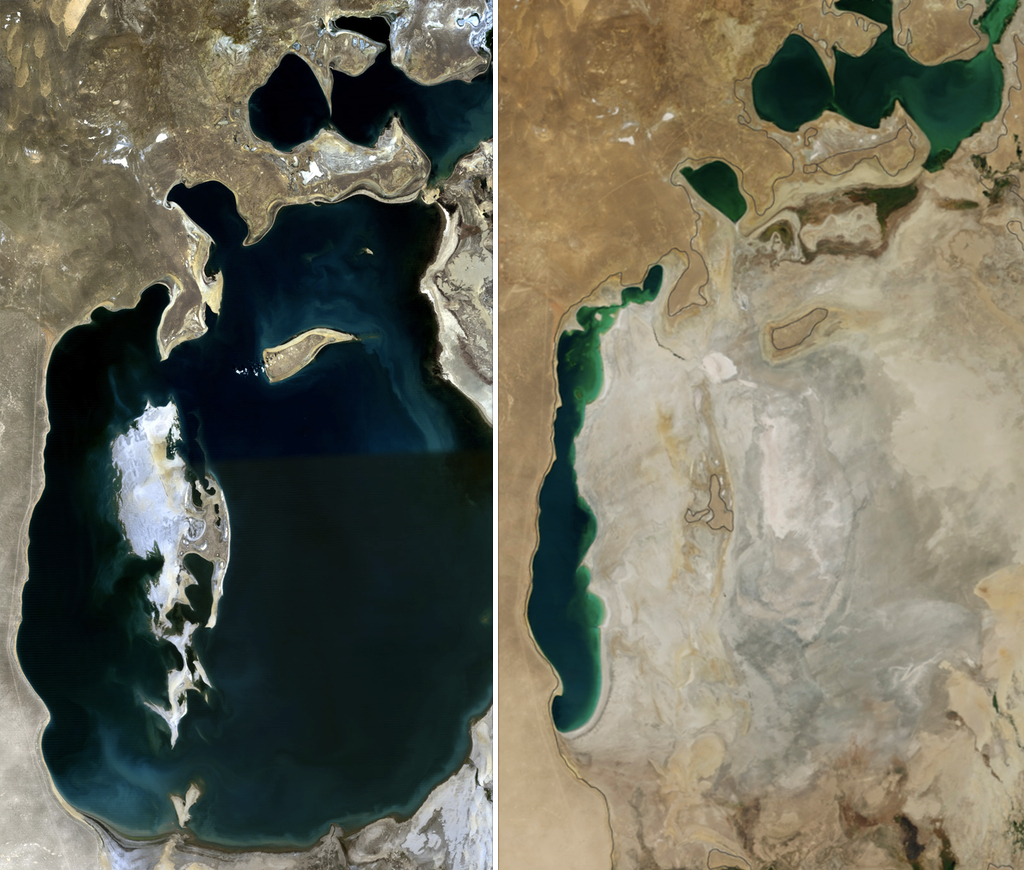
Once, one of the largest low-salinity lakes on the planet stretched across this land. Today, a desert stands in its place. It is called the Aralkum – a desert created not only by natural climate processes, but largely by the human belief that the freshwater resources feeding the lake could be used without limit.
The Aral Sea was once the fourth-largest lake in the world. It lies between present-day Kazakhstan and Uzbekistan and was mainly fed by two major rivers – the Amu Darya and the Syr Darya.
How Do You Drain an Entire Sea?
In the 1960s, the Soviet authorities began the large-scale diversion of water from the Amu Darya and the Syr Darya. The goal was to transform the deserts of Central Asia into enormous irrigated agricultural areas, mainly for cotton production, but also for other crops.
For a while, the plan appeared successful. The desert began to produce crops. Canals carried water to new fields. Production increased. Water was treated as a raw material that could be redirected, pumped and distributed according to the economic objectives of the Soviet Union.
But every new field that began receiving water meant less water for the Aral Sea. The rivers gradually stopped delivering sufficient quantities to it. Evaporation continued, but the inflow could no longer compensate for the losses. The lake began to retreat, divide into separate bodies of water and disappear before the eyes of a single generation.
According to data cited by NASA, between 1960 and 2010, the Aral Sea lost approximately 90% of its surface area and water volume.
The Desert Left Behind by the Water
The Aralkum Desert formed on the former lakebed, covering approximately 60,000 square kilometres according to recent estimates. Winds lift salt and toxic residues from the exposed bottom and carry them across enormous distances.
Dust storms worsen air quality, damage agricultural land, affect public health and create further economic losses. In this way, a water crisis becomes a health, social, agricultural and economic crisis.
And this is precisely the most important lesson of the Aral Sea: water is never just water.
It is food. Energy. Health. Industry. Nature. Regional development. National security.
When the water balance is destroyed, all the other systems begin to disappear with it.
The Small Part That Proves Solutions Exist
The story of the Aral Sea is not entirely a story of defeat.
Kazakhstan built the Kok-Aral Dam, which retains a larger share of the Syr Darya’s water in the northern part of the lake. The project succeeded in raising the water level, reducing salinity and supporting the recovery of fish populations and local fishing.
Of course, this will not bring back the lost sea. But it proves something extremely important: when water is managed deliberately and responsibly, natural and economic systems can recover at least partially.
The problem is that recovery is far slower, more complicated and more expensive than destruction.
Europe, With All Its Freshwater Resources, Is Not So Far From This Story
It is easy to look at the Aral Sea and tell ourselves that this is a distant problem — the result of careless Soviet planning, a desert climate and agricultural practices from another era.
But the mechanism that destroyed it has not remained in the past. It always begins in the same way: we use more water than nature can restore and treat temporary availability as a permanent certainty.
Europe is already warming faster than the global average, while climate change is increasing the risk of more frequent and prolonged droughts. On average, around 30% of the territory of the European Union and one-third of its population experience water scarcity during at least one part of the year.
Pressure on water resources comes simultaneously from almost every part of society and the economy – agriculture, urban water supply, industry, energy production and tourism.
Even when total water abstraction decreases, climate change and the uneven distribution of rainfall can leave entire regions without sufficient water precisely when demand is at its highest.
We have not yet reached the horrifying sight of rusting ships and boats standing on the bottom of a dried-up European water basin. But we are already seeing rivers at record-low levels, towns facing water restrictions, agricultural regions losing crops and energy systems whose output is declining because sufficient water is no longer available.
The Aral Sea is an image of the direction in which prolonged inaction can take us.
At First Glance, Bulgaria Has Water – But Not for Long
Bulgaria still has rivers, reservoirs, groundwater, mountain catchment areas and access to the Black Sea. This creates the dangerous impression that water will always be available.
But the existence of a natural resource does not automatically mean water security.
In its 2026 report on Bulgaria, the European Commission identified water losses of more than 60%. This is the highest level in the European Union.
But another important issue is that we are falling behind in implementing measures to adapt to increasingly frequent climate risks.
For this reason, Bulgaria’s water strategy cannot be limited to urging people to turn off their taps.
We need to reduce losses, introduce modern irrigation, restore water sources, establish regional backup connections, build new reservoirs, reuse treated wastewater and develop additional independent sources.
These sources must include the desalination of seawater – an already accessible technology through which a number of countries have guaranteed their water security and supported their development into leading economic powers.
The Enormous Water Resource We Do Not Use
Most of the planet’s surface is covered by water. Yet societies around the world continue to depend almost entirely on the small and fragile portion that nature has already provided as freshwater in rivers, lakes and underground aquifers.
To some extent, this is understandable. Desalination requires infrastructure, energy, proper resource management and significant initial investment.
But it is no longer an exotic technology.
Modern reverse osmosis is the main method used by new desalination facilities around the world. Billions of cubic metres of desalinated water are produced every year in the Middle East and North Africa, while countries such as the United Arab Emirates, Kuwait and Bahrain rely almost entirely on desalination for their urban water supply.
Singapore operates five desalination plants as part of its diversified national water system. Israel also uses large desalination facilities on the Mediterranean Sea as a strategic part of its drinking-water supply.
These countries did not become wealthy solely because they desalinate seawater. Their accumulated capital allowed them to develop major water infrastructure, but that infrastructure also helped create the conditions for continued economic growth.
Desalination helped them transform a serious natural disadvantage into a manageable system. It provided a predictable resource for their populations, tourism, industry and economic development – regardless of the amount of rainfall in a particular year.
This is the difference between a country that waits for a problem to somehow solve itself and a country that builds its own resilience.
And as we know, a problem left unresolved does not simply disappear. It turns into something much worse.
Desalination Does Not Replace Rivers
Desalination does not remove the need to protect our rivers and restore our water supply networks.
It is an additional source. A reserve. Insurance against climate change, prolonged droughts and seasonal peaks in consumption.
Modern reverse-osmosis facilities generally use approximately 2.5 to 6 kilowatt-hours of electricity to produce one cubic metre of water. The most efficient systems and energy-recovery technologies continue to reduce this consumption.
Combining desalination with renewable energy, batteries and water reservoirs can turn water production into a manageable part of the energy system of the future.
Bulgaria has access to the sea, energy potential and engineering capabilities.
What is still missing is the understanding that water infrastructure must not be built only after the crisis has already begun.
The Warning of the Aral Sea
No one “drinks” an entire sea at once.
It disappears through millions of small decisions, each of which appears too insignificant to cause a catastrophe.
Bulgaria and Europe still have time to choose a different path – to protect their freshwater sources, reduce losses, build reserves and begin using seawater as a genuine strategic resource.
A resource capable of helping them become leading global economies.
And this water security must be built while we still have something left to save…